by Martin Goldberg | Jul 1, 2024 | News
Notice of Consolidated Districts Election will be held on
Tuesday November 5, 2024
Three Full Terms to be elected will expire 12/06/2024 (Incumbents) John Rice, Leona Allen and (Appointed) Tim Cain
The community served by the Lake Valley Fire Protection District (LVFPD) is hereby notified pursuant to California Code, Election Code §12112 that there are three (3) open seats on the Lake Valley Fire Protection District Board due to the expiration of current member seats on 12/06/2024. The elected will represent the community served by the Lake Valley Fire Protection District as a Board Director. The position to be filled is a 4-year term beginning December 2024 and ending December 2028.
Declaration of candidacy forms for eligible candidates desiring to file for any of the elective offices may be obtained from the Elections Department at 3883 Ponderosa Road, Shingle Springs, CA. Forms shall be available commencing on July 15, 2024, before the election, and shall be filed with the Elections Department, in person no later than 5:00 p.m, August 9, 2024, before the election.
For more information, visit https://www.eldoradocounty.ca.gov/County-Government/Elections or call (530) 621-7490. You may also contact Fire Chief Chad Stephen by email at stephen@lakevalleyfire.org or call (530) 577-3737 Ext 6.
Eligibility:
Any person who is 18 years of age or older, a registered voter and resident of the Lake Valley Fire Protection District, and who is not disqualified by the Constitution or laws of the state from holding office, is eligible to be appointed a member of the Board of Directors.
by Martin Goldberg | Jun 17, 2024 | News

The State of California suspended Burn Permits in Alpine, Amador, El Dorado, Eastern Sacramento, and North-Eastern San Joaquin Counties as June 17, 2024. Per Lake Valley Fire local ordinance No. 2022-01, the District prohibits open burning on all lands within the District boundaries within 24 hours of the State restrictions.
Please see Ordinance Section 307.4.4 “Open Burning Restrictions” and Section 202 “Definition of Open Burning”.
Section 307.4.4 Open Burning Restrictions. Open burning on all lands within the jurisdiction of the LAKE VALLEY FIRE PROTECTION DISTRICT (LVFPD), including the Local Response Area (LRA), is prohibited when the California Department of Forestry and Fire Protection (Cal Fire) issues a burn suspension in the State Responsibility Area (SRA). This prohibition shall be made effective 24-hours following its commencement in the SRA.
Open burning is also prohibited on all lands within the jurisdiction of LVFPD at any time the fire code official that atmospheric conditions or other local circumstances make such fires hazardous, including factors such as high winds, low fuel moisture, fire weather, the issuance of red flag warnings, the severe threat of wildland fire, or present risk of destruction by wildfire to life, wildlife, property, or natural resources.
SECTION 202 “OPEN BURNING”
OPEN BURNING. The burning of materials wherein products of combustion are emitted directly into the ambient air without passing through a stack or chimney from an enclosed chamber. Open burning does not include road flares, smudge-pots and similar devices associated with safety or occupational uses typically considered open flames. For the purpose of this definition, a chamber shall be regarded as enclosed when, during the time combustion occurs, only apertures, ducts, stacks, flues or chimneys necessary to provide combustion air and permit the escape of exhaust gas are open.
Open burning shall also include campfires, bonfires, portable outdoor fireplaces, ceremonial fires, and recreational fire as defined in the Fire Code.
Exception:
- UL or ASMI listed LPG or natural gas outdoor flame devices, such as gas BBQ’s or gas fire pits that comply with the Fire Code.
- For one-or two-family dwellings, fixed or portable outdoor flame devices that meet the following:
- Devices shall comply with the Fire Code.
- Devices shall be used per the manufacturer’s specifications.
- Minimum 10-foot clearance from device to all flammable material and vegetation.
- No burning shall be conducted during high or extreme fire weather conditions (e.g., National Weather Service Red Flag Warnings).
- Campfires on private lands. Where required by the fire code official, a permit shall be issued by the fire code official.
- Ceremonial and/or religious burning with the following safety measures:
-
- Maximum 4-foot x 4-foot burn area.
- Minimum 10-foot clearance from the edge of the burn area to all flammable material and vegetation.
- An approved water supply is located within 500 feet of the burn area.
- The burn area is located no less than 30 feet from adjoining property lines.
- An adult is present with a shovel until the fire is extinguished.
- No burning shall be conducted during high or extreme fire weather conditions (e.g., National Weather Service Red Flag Warnings).
by Martin Goldberg | Feb 27, 2024 | News
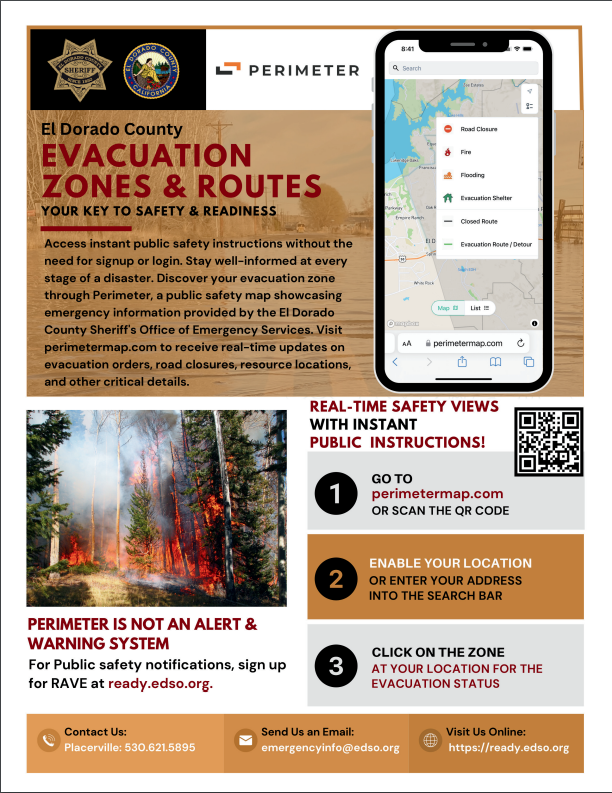
The El Dorado County Sheriff’s Office of Emergency Services (OES) is excited to announce that they have recently acquired Perimeter Platform to bolster their emergency operations and improve communication channels with the public during critical situations. In collaboration with local fire districts and Cal Fire, they’ve worked diligently with Perimeter to segment the County into named zones within this innovative online mapping program. These zone names have been carefully chosen to aid in community recall and facilitate swift action when needed.
Accessible via Perimeter Map (perimetermap.com), the platform provides a comprehensive array of vital information for residents. By simply enabling location services or entering your address, you can locate your position with a blue dot on the map, granting you instant access to critical data such as evacuation zones, routes, road closures, shelter locations, and more. We encourage everyone to take note of their designated zone for prompt action in emergencies.
Perimeter serves as a centralized hub for essential information during crises, particularly wildfires. No registration is required, ensuring accessibility for all. Furthermore, since our mapping covers the entire County, you can stay informed about evacuation orders across various areas. This feature can prove invaluable for assessing proximity to affected zones or monitoring the safety of loved ones residing elsewhere in the County.
It’s important to note that while Perimeter provides comprehensive mapping services, it is NOT an alerting platform. Emergency alerts will continue to be disseminated through El Dorado County Emergency Alerts powered by Rave. Nevertheless, they will include Perimeter’s link in the alerts to facilitate swift access to critical information. We encourage members of our community to bookmark the Perimeter website for rapid retrieval during emergencies. For instance, if you detect smoke in the air, a quick visit to Perimeter can provide clarity on evacuation statuses.
Please refer to the attached flyer for further details, and don’t hesitate to reach out to OES with any inquiries. OES can be reached at (530) 621-5895, by email at emergencyinfo@edso.org, or by visiting ready.edso.org.
Thank you for your attention to this important update. Together, we can enhance our preparedness and response capabilities to safeguard our community.
by Martin Goldberg | Dec 7, 2023 | News, Uncategorized
Happy Holiday Lake Valley Fire District! We have a Holiday Engine tracker. Click the link Santa Tracker. It can be slow to refresh in our District so please continue to look and listen for the engine. Below is the complete schedule.
December 11 – Echo View estates, Tahoe Mountain Road, Mule Deer Circle
December 12 – Lake Tahoe Blvd from Boulder Mountain Drive to Grizzly Mountain Drive
December 13 – West side of North Upper Truckee from Zuni Street Highway 50, Chiapa Drive
December 14 – East side of North Upper Truckee from Grizzly Mountain to West San Bernardino Ave.
December 15 – Christmas Valley from Highway 50 to Grass Lake Road
December 16 –North side of Highway 50 in Meyers (lower Apache, Magnet School), behind Station 7 (Cornelian Drive, Navahoe Drive, Cheyenne Drive).
December 17 – North of Pioneer Trail from Highway 50 to Elks Club (Southern Pines Drive, Tionontati Street, Meadow Vale Drive), Player Drive
December 18 – Upper Apache Drive and Mandan Street
December 19 – Pioneer Trail from Busch Way to Washoan Blvd (Glen Eagles Drive, Hekpa Drive)
December 20 – Pioneer Trail from Washoan Blvd to Jicarilla Drive (Apalachee Drive, Nadowa Street, Susquehana Drive)
December 21 – Kokanee Estates (Marshall Trail, High Meadow Trail)
December 22 – Golden Bear Trail, Meadow View Estates (Plateau Circle, Cattleman’s Trail)
December 23 – Cold Creek Trail, Del Norte Street, Black Bart from Pioneer Trail to Meadow Crest Drive
by Martin Goldberg | Sep 26, 2023 | News
This is an opportunity for the community of South Lake Tahoe to join the Tahoe Fire and Fuels Team and Cal Poly’s Fuels and Vegetation Education Program for a field-based training that spans multiple fires in the Lake Tahoe Basin. Participants will learn how representatives of Tahoe Basin fire agencies worked together to form the Tahoe Fire and Fuels Team with the goal of protecting lives, property, and the environment within the Lake Tahoe Basin from wildfire by implementing prioritized fuels reduction projects and engaging the public in becoming a Fire Adapted Community.
In this field training, we will visit several sites within the South Lake Tahoe community to better understand how the Gondola and Angora fires played a critical role in the outcome of the Caldor Fire. Participants will learn about how local fuels reduction projects helped to slow the spread of fire and decreased fire severity, protected resources, and ultimately saved lives, homes, and communities. The goal of this training is to provide an opportunity for participants to learn more about what local agencies are doing to prepare for and prevent wildfires in the Lake Tahoe Basin. This training is an opportunity for agencies to engage in skills-based advocacy building exercise with local community leaders in an effort to create consistent messaging within the community and grow the local network of Fire Adapted Communities.
Lake Tahoe Basin Field Training Flier
Agenda
| TIME |
ITEM |
| 10:00am |
Workshop begins |
|
Angora Ridge Lookout |
|
Chief Chad Stephen: Welcome |
|
Chief Jim Drennan: Relationships & Collaborations |
|
Martin Goldberg: Fire History |
|
Mike Vollmer: Fire History Continued |
|
Old Meyers Grade |
|
Brian Newman: Christmas Valley and Caldor Fire Overview |
|
Martin Goldberg: Community Teachings and Collaborations |
|
Chief Jim Drennan: Stateline to Summit |
| 1:00pm |
Working lunch at California Conservation Core Convention Center |
| 2:00pm |
Pawnee Circle Neighborhood |
|
Brian Newman: Living in a Fire Prone Community |
|
Vic Lyon: Community Action Now vs. in the Past |
|
Nadia Tase: Fuel Reduction Treatment Types in the WUI |
|
Martin Goldberg: Treating State vs. Private Lots |
|
Mike Vollmer: Open Space Management |
|
Fountain Place |
|
Vic Lyon: Timeline for Fuels Reduction Projects: Planning and Implementation |
|
Nadia Tase: Treatment Impacts, Challenges, and Barriers |
|
Brian Newman: Fuel Reduction in National Forest Land |
|
Lower Corral Trailhead |
|
Vic Lyon: Fire Severity Effects in Untreated Forest |
|
Nadia Tase: Climate Change and Wildfire in the Sierras |
|
Mike Vollmer: Fire Adapted Landscapes and Communities: Role of Good Fire |
|
Martin Goldberg: Community Wildfire Protection Plan (CWPP) |
|
Brian Newman: Ready, Set, Go Messaging |
|
Kelly Meyer: Skills-Based Advocacy Building Exercise |
| 5:00pm |
Field Training Ends |
Trainers:
Brian Newman, Assistant Chief, CAL FIRE Amador-El Dorado Unit, East Division Operations, Lake Tahoe Ca.
Brian has worked for CAL FIRE for 29 fire seasons in the Amador – El Dorado Unit. He has been assigned to various programs including Schedule A and Schedule B fire suppression, Emergency Command Centers, and the unit Vegetation Management Program / Fuels reduction program. He Graduated from Cogswell Polytechnical College with a B.S. in Fire Management and Technology. Brian’s current position is the Assistant Chief of the East Division of AEU, which includes Lake Tahoe and Alpine County and a Fire Crew fire center. Brian is a member of CAL FIRE Incident Management Team 3 as the Fire Behavior Analyst and instructs on numerous cadres including Prescribed Fire Incident Commander, and the Fire Behavior series.
Nadia Tase is a Senior Environmental Scientist working for the Fire and Resource Assessment Program in CAL FIRE. She focuses on issues surrounding forest and harvested wood product carbon sequestration. Prior to working for CAL FIRE, Nadia worked for the U.S. Forest Service, Lake Tahoe Basin Management Unit as a Forester preparing and implementing fuel reduction projects in the Tahoe Basin.
Victor Lyon, Vegetation Management Staff Officer, USDA Forest Service, Lake Tahoe Basin Management Unit
Victor Lyon is currently the Vegetation Management Staff Officer at the USDA, Forest Service, Lake Tahoe Basin Management Unit. He graduated from UC Davis with a degree in Wildlife and Fisheries Biology, specializing in conservation biology, worked for three years with the Fish and Wildlife Service, and then joined the Forest Service in 2000 here in Lake Tahoe. Victor worked as a wildlife biologist for thirteen more years with the Forest Service, then as a District Ranger for five years, and in his current position since 2018. He grateful for the privilege and opportunity to continue managing forest health and fuel reduction projects with a holistic land stewardship approach on forest system lands and across ownerships with excellent partners in the Lake Tahoe area. Victor enjoys hiking, backpacking, mountain biking, rafting, snowboarding on our public lands.
Fire Captain Martin Goldberg has nearly 25 years in the fire service, having worked previously for San Luis Obispo County Fire / CALFIRE and the Bureau of Land Management (BLM) before starting his career with the Lake Valley Fire Protection District (LVFPD) in 2001. Captain Goldberg is currently assigned to the LVFPD Prevention Division. Captain Goldberg holds a degree in Soil Science with a concentration in Environmental Science from Cal Poly San Luis Obispo. Captain Goldberg has actively participated in the Tahoe Fire and Fuels Team (TFFT) since its inception in 2008 and is recognized by the Tahoe Regional Planning Agency (TRPA) as a qualified forester. Captain Goldberg has fostered defensible space and home hardening on private lands in South Lake Tahoe for close to 15 years.
Mike Vollmer is the Executive Director at the Tahoe Resource Conservation District with a career spanning over three decades in natural resource management. He has worked in the Lake Tahoe region since 2001. Mike’s passion lies in preparing communities for wildfires, sustainable resource management, disturbance ecology, and restoration ecology (including prescribed fire). Mike is a Registered Professional Forester (RPF) and Certified Arborist and has held key positions at organizations such as the Institute for Sustainable Forestry, Tahoe Regional Planning Agency, Nevada Fire Safe Council, North Tahoe Fire Protection District, Nevada Division of Forestry, and now at the Tahoe Resource Conservation District. In his role as Executive Director, Mike Vollmer combines his academic knowledge with practical experience, driving positive change in the realm of environmental stewardship.