by Martin Goldberg | Jun 22, 2026 | News
Draft Hazard Mitigation Plan
STPUD and LVFPD are now soliciting public comment on the draft Hazard Mitigation Plan before it is finalized and submitted to FEMA for review and approval. The public comment period is open from June 22, 2026 to July 13, 2026. Follow the link to provide feedback on the plan.
Why Your Voice Matters:
Community participation ensures the updated plan is:
- Informed by real experiences and local knowledge.
- Supported by STPUD customers and community members.
- Practical, effective, and ready to be implemented.
Background
The South Tahoe Public Utility District (STPUD) and Lake Valley Fire Protection District (LVFPD) are working together to update our Multi-Jurisdictional Hazard Mitigation Plan. This federally required plan identifies natural hazards, assesses risks, and outlines strategies to protect our community from disasters like wildfires, floods, and droughts. Updated every five years, the Hazard Mitigation Plan keeps participating jurisdictions like STPUD and LVFPD eligible for Federal Emergency Management Agency (FEMA) and state grants, while serving as a blueprint for protecting lives, property, and the environment.
What is Hazard Mitigation?
Hazard mitigation refers to proactive actions taken to reduce or eliminate long-term risks from natural hazards. Rather than just rebuilding after a disaster, hazard mitigation aims to break the cycle of damage and costly recovery.
Examples include:
- Improving infrastructure to withstand wildfires or floods
- Updating building codes to reflect modern risks
- Preserving open space to reduce flood impacts
When local governments and agencies plan ahead, we create stronger, safer, and more resilient communities that can better weather future disasters.
Why this Matters?
Mitigation is an investment in a community’s future safety, sustainability, and resiliency. Studies show every $1 spent on mitigation saves $6 in disaster costs. By planning ahead, we reduce the impact when disasters strike, keeping our community safer and more resilient.
How does this benefit South Lake Tahoe?
Hazard mitigation planning allows residents, business owners, elected officials, special districts, and municipalities to think through how to plan, design, build, and establish partnerships for risk reduction. Hazard mitigation can also benefit a community or a special district by:
- Protect public safety and prevent injuries.
- Safeguard homes, businesses, and future development.
- Preserve our unique economy, culture, and natural environment.
- Speed recovery and minimize downtime after disasters.
- Lower disaster response and recovery costs.
- Support infrastructure upgrades and open space preservation
For STPUD and LVFPD specifically, the plan update will:
- Keep us eligible for critical FEMA mitigation funding.
- Increase public awareness about local risks and safety actions.
- Align policies and programs to reduce vulnerability to all hazards.
- Build strong partnerships with community groups and stakeholders.
- Expand strategies to include education, regulations, and innovative projects.
- Guide prioritization and implementation of effective mitigation actions.
For More Info:
Call South Tahoe Public Utility District at 530-544-6474 or email info@stpud.us; or Lake Valley Fire District at 530.545-2065 or goldberg@lakevalleyfire.org.
by Martin Goldberg | Jun 16, 2026 | News
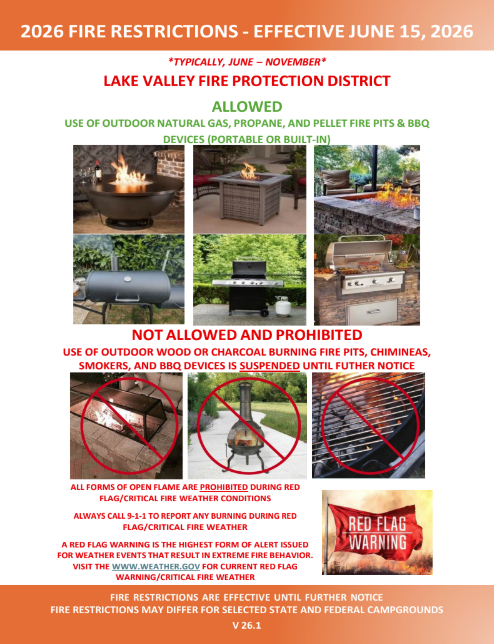
Lake Valley Fire Protection District Prohibits ALL Open Burning and Recreational Fires
Meyers, Calif. – June 15, 2026 – Following the suspension of residential burn permits by CAL FIRE, Lake Valley Fire Protection District is implementing local fire restrictions effective Monday, June 15, 2026, at 8:00 a.m. The restrictions will remain in place for the duration of fire season.
Under the 2024 Fire Code, all open burning and solid-fuel recreational fires are prohibited during fire season.
Only Natural Gas (NG) and Propane (LPG) outdoor fire pits, barbecues, and pellet grills/smokers are permitted during fire season and must be operated according to the manufacturer’s instructions. However, all outdoor flame-producing devices, including gas and propane appliances, are prohibited during Red Flag Warnings and other critical fire weather conditions. Open-flame devices such as tiki torches and all fireworks, including sparklers and firecrackers are illegal in California year-round.
To report hazardous or illegal campfires, call 9-1-1. Illegal fireworks activity should be reported to local law enforcement at (530) 573-3000.
Red Flag Warnings and Watches for the Tahoe Basin are issued by the National Weather Service Reno.
Residents are encouraged to take steps now to prepare their homes and properties for wildfire:
• Maintain at least 5 feet of noncombustible space around structures.
• Keep the area within 30 feet of your home Lean, Clean, and Green.
• Remove dead or dying vegetation within 100 feet of structures.
• Landscape with fire-resistant plants.
• Use chipping programs (Chipper Day) or green waste collection services to dispose of vegetation.
For information about defensible space, wildfire preparedness, and evacuation planning, visit TahoeLivingWithFire.com.

by Kayla Galvan | Feb 17, 2026 | News
The Board of Directors of Lake Valley Fire Protection District engaged Ridgeline Municipal Strategies to perform a study to determine what the District should charge for mitigation fees. The study, along with associated documents, will be made available to the public for inspection between 9:00am and 4:00pm at 2211 Keetak St. South Lake Tahoe, CA beginning March 2, 2026. The Documents will also be available to view on the District’s website, www.lakevalleyfire.org.
The Board will hold a public hearing at 4:00pm on Thursday March 12, 2026 for constituents to provide input on the mitigation fee study and proposed changes. The hearing will occur in open session during the Board’s regularly scheduled monthly meeting at 2211 Keetak St. South Lake Tahoe, CA. Any person may appear and be heard during the public comment section of the public hearing.
by Martin Goldberg | Jan 27, 2026 | News

The City of South Lake Tahoe along with the Lake Valley Fire Protection District is recruiting for two Fuel Reduction Crew Leads, six crewmembers and 2 defensible space inspectors for the summer season.
The start date for these positions is anticipated to start around April 15 – April 30, 2026 depending on weather conditions, and will go for 6 months at 40 hours per week, or 960 hours total. The anticipated end date for this position is mid to late October 2026.
Applications will be accepted until February 20, 2026. Interviews will take place in late February.
For questions regarding this role, please contact Jay Manning, Fire Division Chief at JManning@cityofslt.gov.
by Martin Goldberg | Nov 17, 2025 | News, Uncategorized
South Tahoe Public Utility District (STPUD) and Lake Valley Fire Protection District (LVFPD) have started an update of their Multi-Jurisdictional Hazard Mitigation Plan. The plan will develop near-term and long-term mitigation actions that reduce risk from drought, floods, winter storms, wildfires, and other natural hazards.
“Community input is essential to set priorities and identify projects,” said Megan Colvey, Director of Engineering with STPUD.
Hazard mitigation means taking actions that reduce or eliminate long-term risk to people, property, infrastructure, the economy, and the environment.
“Planning before a disaster helps us prioritize safety and protect our community,” said Colvey.
National studies show communities gain strong value from mitigation investments, with significant savings for every dollar spent. A plan that is updated every five years, also keeps the
STPUD and LVFPD eligible for state and Federal Emergency Management Agency (FEMA) Hazard Mitigation Assistance grant funding.
The update will follow FEMA guidance through a four-phase, nine-step planning process during 2025 and 2026. A Hazard Mitigation Planning Committee will help steer the work and ensure
broad participation by residents, businesses, partner agencies, and community organizations.
How to participate
Take the public survey (Click here) to share your experience with local hazards and ideas for risk reduction. The survey is available in English and Spanish and remains open through
November 30, 2025.
Attend the Public Workshop in 2026 once the draft Plan is ready for review.
Stay updated by visiting: www.stpud.us/hazard-mitigation-plan-update
Benefits to the community include protecting public safety, reducing damage to existing and future development, hardening critical water and wastewater infrastructure, and minimizing service disruptions. STPUD and LVFPD will use community input to identify and prioritize a portfolio of mitigation actions.
“We encourage everyone on the south shore to take a few minutes to complete this survey to help your water/sewer and fire districts understand your concerns,” said Colvey.
If you have questions, call STPUD at (530) 544-6474 or email info@stpud.us. For Lake Valley Fire Protection District questions, contact us at (530) 725-9499 or email
by Kayla Galvan | Sep 16, 2025 | News
Notice is hereby given to the intention of the Board of Directors of the Lake Valley Fire Protection District to adopt the 2025 California Fire Code with local amendments. The Board of Directors will hold its second hearing at 4:00pm on Monday, September 29th, 2025 at the LVFPD Fire Station 7, 2211 Keetak St. South Lake Tahoe, CA, regarding the adoption of the 2025 California Fire Code with local amendments, pursuant to Health and Safety Code Section 13869 and 13869.7. Copies of the code section referred to, and any secondary code sections referred to, adopted by reference, are on file with the District’s Administrative Assistant, and are open to public inspection. Adoption of the Fire Code Ordinance will adopt the California Fire Code as currently published in Title 24, Part 9, of the California Code of Regulations. In some instances the Lake Valley Fire Protection District’s proposed Fire Code Ordinance proposes building standards more stringent than those minimum building standards adopted by the State Fire Marshal and contained in the California Building Standards Code.
Fire Code 2025 final document