by Martin Goldberg | Oct 4, 2021 | News

Fire Prevention Week™ October 3-9th
“Learn the Sounds of Fire Safety™”
The Lake Valley Fire Protection District is teaming up with the National Fire Protection Association® (NFPA®)—the official sponsor of Fire Prevention Week for more than 90 years—to promote this year’s Fire Prevention WeekTM campaign, “Learn the Sounds of Fire SafetyTM.” This year’s campaign, October 3-9th, works to educate everyone about simple but important actions they can take to keep themselves and those around them safe.
“What do the sounds mean? Is there a beep or a chirp coming out of your smoke or carbon monoxide
alarm? Knowing the difference can save you, your home, and your family,” said Lorraine Carli, vice-president of outreach and advocacy at NFPA.
The Lake Valley Fire Protection District encourages all residents to embrace the 2021 Fire Prevention Week theme.
It’s important to learn the different sounds of smoke and carbon monoxide alarms. When an alarm makes noise—a beeping sound or a chirping sound—you must take action! Make sure everyone in the home understands the sounds of the alarms and knows how to respond. To learn the sounds of your specific smoke and carbon monoxide alarms, check the manufacturer’s instructions that came in the box, or search the brand and model online.
The Lake Valley Fire Protection District wants to share safety tips to help you “Learn the Sounds of Fire Safety”
- A continuous set of three loud beeps—beep, beep, beep—means smoke or fire. Get out, call 9-1-1, and
stay out.
- A single chirp every 30 or 60 seconds means the battery is low and must be changed.
- All smoke alarms must be replaced after 10 years.
- Chirping that continues after the battery has been replaced means the alarm is at the end of its life and
the unit must be replaced.
- Make sure your smoke and CO alarms meet the needs of all your family members, including those with sensory or physical disabilities.
The Lake Valley Fire Protection District is posting a series of tips on our Instagram (@lakevalleyfire) and Facebook (https://www.facebook.com/LakeValleyFire) sites in support of this year’s Fire Prevention Week campaign, “Learn the Sounds of Fire Safety.”
To find out more about Fire Prevention Week, please contact the Lake Valley Fire Protection District’s Public Information Officer Martin Goldberg at (530) 577-3737 or by email at goldberg@lakevalleyfire.org. For more general information about Fire Prevention Week and fire prevention in general, visit www.fpw.org.
by Martin Goldberg | Aug 26, 2021 | News
Tahoe Fire and Fuels Team
August 26th, 2021
Contact: Amanda Milici, Tahoe Resource Conservation District, (530) 543-1501 x 114
LAKE TAHOE, Calif./Nev. – Since the 2007 Angora Fire, the Tahoe Fire and Fuels Team (TFFT) has completed 65,000 acres of treatment to reduce hazardous fuels in the Tahoe Basin. These restoration projects improve the vitality of the basin’s forests to withstand the increasing threats of drought and other extreme weather events. With the Caldor Fire nearby, we want to share what you can do individually to complement the work that the TFFT is doing to prepare for wildfire.
Monitor Incident Information – Stay up to date on the current acreage and containment statistics by visiting the incident page here and sign up to receive CAL FIRE updates here. For current evacuation locations, check the El Dorado County Sherriff Evacuation Map. For the latest Caldor Incident information, attend a live CAL FIRE AEU community meeting daily at 5PM at www.facebook.com/CALFIREAEU.
Highway 50 is closed in both directions from Pollock Pines (Sly Park Road exit) to Meyers. Check the CAL FIRE incident page and the Caltrans QuickMap for road closure updates.
Sign Up for Emergency Alerts –You should take initiative by signing up for emergency alerts. Placer Alert, El Dorado County Code Red, Douglas County Code Red, and Washoe County Code Red allow individuals to register up to five addresses for notifications. Those who often travel around Lake Tahoe should sign up for all four counties.
Prepare an Evacuation Go-Bag – Prepare a Go-Bag in advance, and include 3-5 days of supplies you would need to self-sustain should you be ordered to evacuate. Include essentials such as clothes, toiletries, prescriptions, food, water, cash and pet supplies. Make sure your personal documents (such as social security card, passport, and memorabilia) are accessible. Consider adding a USB drive with copies of these documents to your Go-Bag.
Plan for a Potential Evacuation – Evacuating can be stressful and scary, so you should have a plan. Familiarize yourself with your neighborhood, identify potential escape routes, and build relationships with your neighbors, especially if you do not have a car. Learn how to turn off the gas and electricity at your home, designate a family meeting point, and identify an out-of-town contact. Prepare to address the special needs of vulnerable family members and neighbors, including the elderly and those with medical problems or disabilities. In the event that you have to evacuate, use this Wildfire Evacuation Checklist for guidance. Practice the plan with your family, pets and neighbors. Muscle memory will help in times of real emergency.
Do a Home inventory – If, and only if, you have time, consider documenting your important items in the event you need to file an insurance claim. Document your home inventory here or use the home inventory app here. Take photos and/or videos of your most important items.
Visit TahoeLivingWithFire.com and follow @tahoelwf on Facebook, Instagram, and Twitter for more wildfire preparedness and prevention information.
About the Tahoe Fire and Fuels Team – The Tahoe Fire and Fuels Team (TFFT) consists of representatives of Tahoe Basin fire agencies, CAL FIRE, Nevada Division of Forestry and related state agencies, University of California and Nevada Cooperative Extensions, the Tahoe Regional Planning Agency, the USDA Forest Service, conservation districts from both states, the California Tahoe Conservancy and the Lahontan Regional Water Quality Control Board. Our Mission is to protect lives, property and the environment within the Lake Tahoe Basin from wildfire by implementing prioritized fuels reduction projects and engaging the public in becoming a Fire Adapted Community.
by Martin Goldberg | Aug 22, 2021 | News
Caldor Fire Information
 The Lake Valley Fire Protection District appreciates your efforts to stay informed on this rapidly changing wildfire. The District is working closely with the Caldor Fire Incident Management Team including CALFIRE and the U.S. Forest Service and will continue to do so throughout the incident. All our actions are based on the most current fire information. The District wants our community to be informed and provide the following incident information. The incidents information line is (530) 303-2455 and the media line is (530) 497-0315.
Fire Information
The Caldor Fire Public Information Team provides information twice daily, at 7 am and at 7 pm. Other notices regarding evacuations, smoke impacts and community meetings are released throughout the day. These can be obtained directly by email or by social media. For emails, click here. To Like the CALFIRE Amador-El Dorado Unit Facebook page and get incident updates, click here. To Like the U.S. Forest Service – Eldorado National Forest Facebook page and get incident updates, click here.
Statewide fire Information can be found on CALFIRE’s main website at www.fire.ca.gov. For Caldor Fire information on CALFIRE’s website click here https://www.fire.ca.gov/incidents/2021/8/14/caldor-fire/. Another great resource for fire information, go to InciWeb at https://inciweb.nwcg.gov/. Calfor fire information can be found on the InciWeb site at https://inciweb.nwcg.gov/incident/7801/.
Evacuation Information
Please note, there is no evacuation order, nor warning, issued in the Lake Tahoe Basin area as of Sunday, August 22. However, this is a good time to assemble an emergency supply kit should the need arise to evacuate. You can find information at Emergency Supply Kit – Ready for Wildfire. Additionally, information on how to prepare family members in the event of an evacuation can be found at Prepare Your Family – Ready for Wildfire. Click the map for current El Dorado County Evacuation information.
by Martin Goldberg | Jun 21, 2021 | News
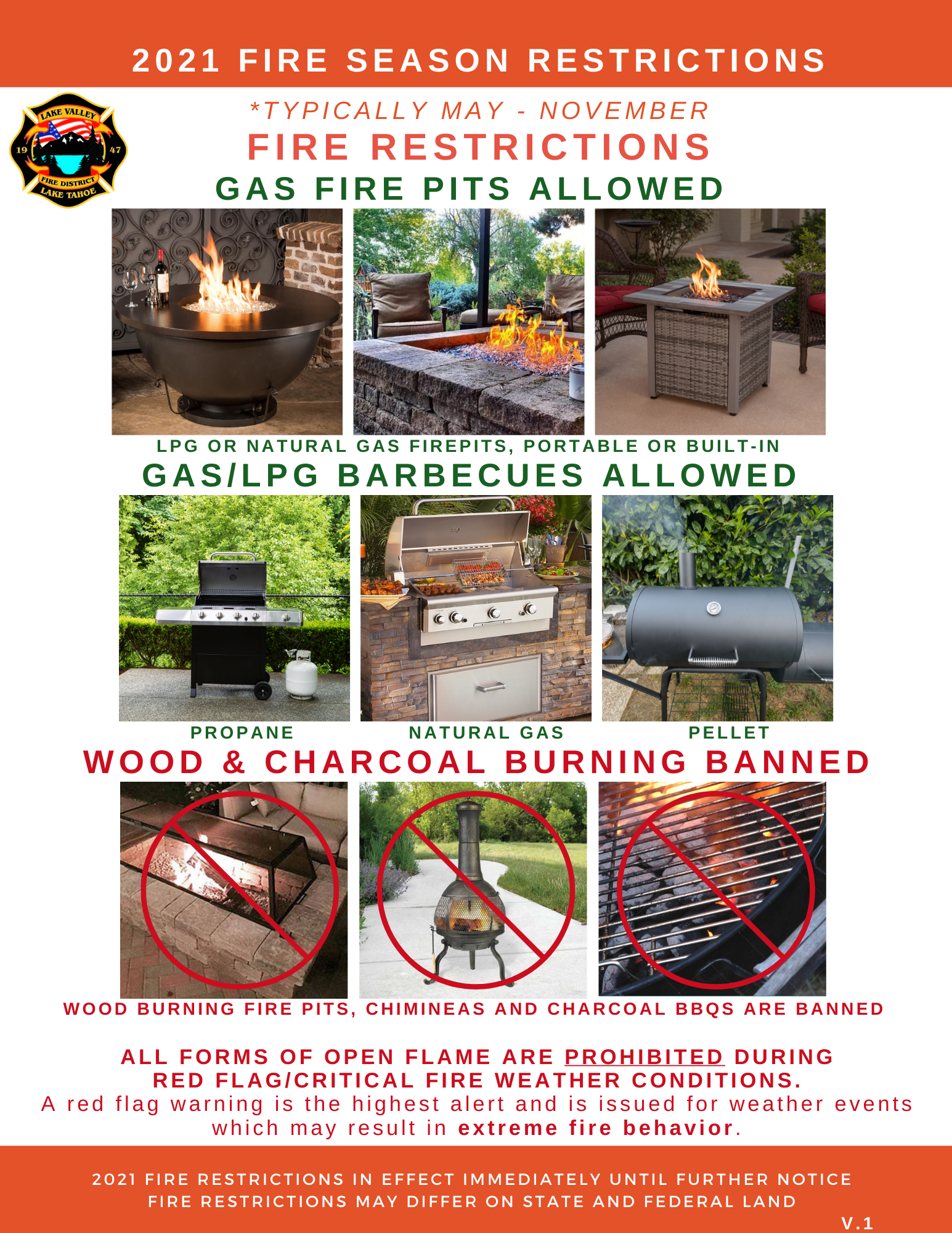
Enhanced fire restrictions began June 15, 2021, and will remain in effect through November or until rescinded. Wood and charcoal fires and other fire-related activities are prohibited in the Lake Valley Fire Protection District. Increased fire danger due to severe drought conditions and warm weather is a big concern this summer. Enhanced fire restrictions will help reduce the possibility of human-caused fires.
by Martin Goldberg | Jun 15, 2021 | News
Forest Service News Release
Public Affairs Specialist: Lisa Herron
(530) 721-3898
lisa.herron@usda.gov
www.fs.usda.gov/ltbmu
www.facebook.com/LakeTahoeUSFS/
twitter.com/LakeTahoeUSFS
Enhanced fire restrictions begin June 15 at Lake Tahoe
SOUTH LAKE TAHOE, Calif., June 15, 2021 – Enhanced fire restrictions begin today, June 15, 2021, and will remain in effect through November or until rescinded. Wood and charcoal fires and other fire-related activities are prohibited on National Forest System lands in the Lake Tahoe Basin, including developed campgrounds. Illegal campfires cause over 90 percent of the wildfires at Lake Tahoe and increased fire danger due to severe drought conditions and warm weather is a big concern this summer. Enhanced fire restrictions will help reduce the possibility of human-caused fires.
Pursuant to 16 USC 551 and 36 CFR 261.50(a), and to provide for public safety and protect natural resources, the following acts are currently prohibited within the Lake Tahoe Basin Management Unit:
- Building, maintaining, attending, or using a fire, campfire, or stove fire, including charcoal briquettes and wood, on National Forest System lands. 36 CFR 261.52(a).
- Smoking, except within an enclosed vehicle, or while stopped in an area at least three feet in diameter that is barren or cleared of all flammable material. 36 CFR 261.52(d).
- Operating an internal combustion engine off paved, gravel, or dirt National Forest System roads and trails, except within the Sand Pit Off-Highway Vehicle Area and boats on a water surface. 36 CFR 261.52(h).
- Welding or operating an acetylene torch with open flames. 36 CFR 261.52(i).
In addition to the restrictions listed above, possessing, discharging, or using any kind of firework, including sparklers and firecrackers, and any other pyrotechnic device is always prohibited.
Pursuant to 36 CFR 216.50 (e), persons with a valid Wilderness Permit or a California Campfire Permit may use a portable campfire pit, lantern or stove that uses gas, kerosene, jellied petroleum, or pressurized liquid fuel, with a shut-off valve, in an area at least three feet from any flammable materials. California Campfire Permits are free and available online at https://www.readyforwildfire.org/permits/campfire-permit/.
At the following National Forest beaches, campgrounds and resorts, portable gas appliances with a shut-off valve are permitted without a California Campfire Permit: Baldwin, Meeks Bay, Nevada, Pope, and William Kent beaches; Fallen Leaf, Meeks Bay, Nevada and William Kent campgrounds; and Camp Richardson, Meeks Bay and Zephyr Cove resorts.
A violation of these prohibitions is punishable by a fine of not more than $5,000 for an individual or $10,000 for an organization, or imprisonment for not more than six months, or both, 16 USC 551 and 18 USC 3559, 3571, and 3581.
The enhanced fire restriction Forest Order is posted at https://go.usa.gov/xVfjp. For more information on fire restrictions, visit https://go.usa.gov/xVDZw.
Information about private and state land fire restrictions, regulated by the California Department of Forestry and Fire Protection (CALFIRE), is available at https://burnpermit.fire.ca.gov/current-burn-status/ or from local fire districts.
###